A classroom that needs instant feedback has three honest options in 2026: buy a set of clickers and own them, rent a polling app every year and hope every student has a charged phone on the network, or call a voting-systems company and wait for a quote. Those are three different budget lines, three different failure modes, and three different answers to the same question. Here is how the entry-level QOMO QClick QRF300 stacks up against the strongest example of each alternative.
The one-line answer: buy the QOMO QClick QRF300 (from $687.88 for the 12-remote QRF312 kit up to $1,588.88 for the 32-remote QRF332) when students should not need phones, Wi-Fi, or accounts to answer a question. It is a one-time purchase, roughly $50 to $57 per seat depending on kit size, and the school keeps the hardware. Choose Poll Everywhere when every participant already carries a device on reliable Wi-Fi and you would rather pay per presenter each year, with K-12 premium listed near $50 per year and the Present plan at $120 per year. Choose Meridia EZ-VOTE when the room is a town meeting, board vote, or CME session rather than a classroom, and you need weighted or anonymous voting with a longer 200 to 450 foot range. For most K-12 classrooms the QRF300 is the pick, because it is the only one of the three that keeps working when the network does not.
Read More
| Tool / Business / Provider | Score | Speed / Distance | Pricing / Details | Rating |
|---|---|---|---|---|
| Top Choice | No Wi-Fi needed | From $687.88 (12-seat kit) | ★★★★★ | |
| Instant setup | From about $50/yr (K-12), $120/yr Present plan | ★★★★☆ | ||
| Quote required | Quote only (no published price) | ★★★★☆ |
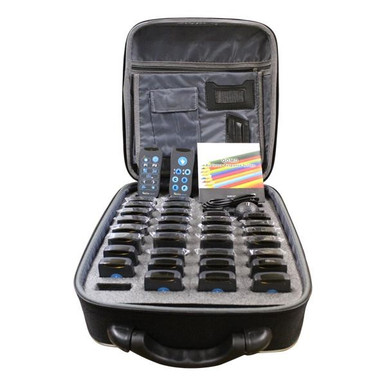
The QOMO QClick QRF300 is the entry point in QOMO's response line and the most classroom-shaped product in this comparison. It is sold as a class pack: RF student remotes, a teacher remote, and a receiver, all bought once and owned by the building. Nothing in the workflow depends on a student device, a login, or the wireless network, which is exactly why it survives the two situations that break app-based polling, a saturated Wi-Fi access point and a phone-free classroom policy.
If you want the same approach with more headroom, the QRF500 steps up to 400 devices and a 250-foot range. For a single classroom on a fixed budget, the QRF300 does the job for less money and nothing recurring.
Read More : https://www.encoredataproducts.com/audience-response-systems/qomo-qclick-qrf300-audience-response-system/Poll Everywhere is the strongest example of the model that has taken most of this market: browser-based polling answered on whatever phone, tablet, or laptop the participant already carries. There is no hardware to purchase, store, or replace, and the pricing is per presenter rather than per participant, so one teacher running polls for 400 students still pays for a single seat. For a lecturer with a reliable network and an adult audience, that is hard to argue with.
The weaknesses are structural, not cosmetic: it needs a device in every hand and a network that can carry them, it costs money every single year with nothing owned at the end, and in a district with a phone-free policy or a 1:1 fleet that stays locked down, it simply cannot run the lesson.
Read More : https://www.polleverywhere.com/plansMeridia Interactive Solutions is one of the longest-running audience response vendors in the United States, and its EZ-VOTE keypads serve a market QOMO's classroom line does not chase: town meetings, association votes, continuing medical education, and government sessions. The EZ-VOTE 10 is the middle keypad in a four-model family, sized for trainers, educators, speakers, and electors, and it pairs with the EZ-VOTE Connect software suite and a PowerPoint voting plugin.
If your requirement is a recorded, procedurally correct vote in a hall full of adults, Meridia is a serious answer and QOMO is not really competing for that job. If your requirement is a teacher checking comprehension in third period, the quote cycle and the voting-first feature set are overhead you do not need.
Read More : https://www.meridiaars.com/electronic-voting-devices/
No hardware to buy, but every student needs a device and a signal
Meridia EZ-VOTE lands third here only because this article is written from a classroom budget. Judged on its own turf, a municipal vote or a CME session where responses have to be recorded correctly and anonymously, it beats both other systems easily, and the 450-foot HD and PRO models reach rooms neither QOMO kit is rated for. What sinks it for a school is the buying experience and the fit: quote-only pricing with no published number, a feature set built around motions and ballots rather than quizzes, and no path to put it on the same purchase order as the headphones, document cameras, and panels a district is already ordering. If you are a town clerk, call Meridia. If you are a curriculum director, buy the QRF300.

Start with one question: can you guarantee a charged, connected device in every hand, every time? If the answer is no, and in most K-12 classrooms it is no, buy the QOMO QClick QRF300. The QRF312 12-remote kit is $687.88, the QRF324 is the 24-remote step, and the QRF332 32-remote kit is $1,588.88, each including a teacher remote and receiver, with no annual fee behind it. That is roughly $50 to $57 per seat, once, for a system that works with the Wi-Fi down and the phones in the pouch.
If your audience is adults on reliable Wi-Fi and you would rather expense a subscription than a capital purchase, Poll Everywhere is the cleanest version of that model. If you are running formal votes rather than lessons, get a quote from Meridia. For everything in between, Encore Data Products stocks the QOMO QClick line with published pricing, accepts school and district purchase orders, and sells through TIPS 230901 and Choice Partners. Call 866-926-1669 to size a kit or compare the QRF300 against the larger QRF500.